Premium Icynene Ultra 50
Open-cell · Interior only
Ignition-barrier-free in unventilated attics
R-3.81aged, per inch

The only insulation that seals the building instead of just filling it. Applied by an owner-operated crew across the Rio Grande Valley and the San Antonio metro.
Get a Free EstimateBatts and blown-in insulation slow heat down. They don't stop air. Every gap around a vent, a top plate, a can light, or a skylight is a hole your conditioned air escapes through — and in August in the Valley, that's the hole your electricity bill goes out of too.
Spray polyurethane foam goes on as a liquid and expands in place. It fills the cavity and bonds to whatever it touches, so the insulation layer and the air barrier become the same layer. There's no gap for it to miss, because it's forming itself around the framing rather than being cut to fit it.
That's the whole difference. It costs more per square foot than fiberglass and it does a job fiberglass structurally cannot do.
Two different materials for two different jobs. Anyone who tells you one is simply better than the other is selling you the one they'd rather spray.
| Open-Cell | Closed-Cell | |
|---|---|---|
| Aged R-value | R-3.81 per inch | R-7.4 per inch |
| Density & feel | Light, soft, sponge-like. Expands far into tight cavities. | Dense and rigid. Forms a hard, solid layer. |
| Air barrier | Yes, at the right thickness | Yes |
| Vapor / moisture | Permeable — lets assemblies dry out | Class II vapor retarder at 2″; also a water-resistive barrier |
| Structural effect | None | Adds rigidity to walls and roof decks |
| Sound damping | Excellent — the better choice for noise | Moderate |
| Application | Interior only | Interior and exterior, above and below grade |
| Cost tier | $$ — more coverage per dollar | $$$ — higher cost, higher performance per inch |
| Best used for | Unvented attics, interior walls, ceilings, sound control | Metal buildings, crawl spaces, exterior walls, cold storage, roofs, anywhere moisture is a factor |
Huntsman Building Solutions systems — Icynene and Heatlok. We'll name the product and the thickness on the quote, before you sign it.
Open-cell · Interior only
Ignition-barrier-free in unventilated attics
Closed-cell · Interior, above and below grade
Air barrier, vapor retarder and water-resistive barrier
Closed-cell · Interior and exterior
Up to 6.5″ lift per pass — fewer passes, faster job
Closed-cell · Interior and exterior, above and below grade
NFPA 285 approved · Greenguard Gold
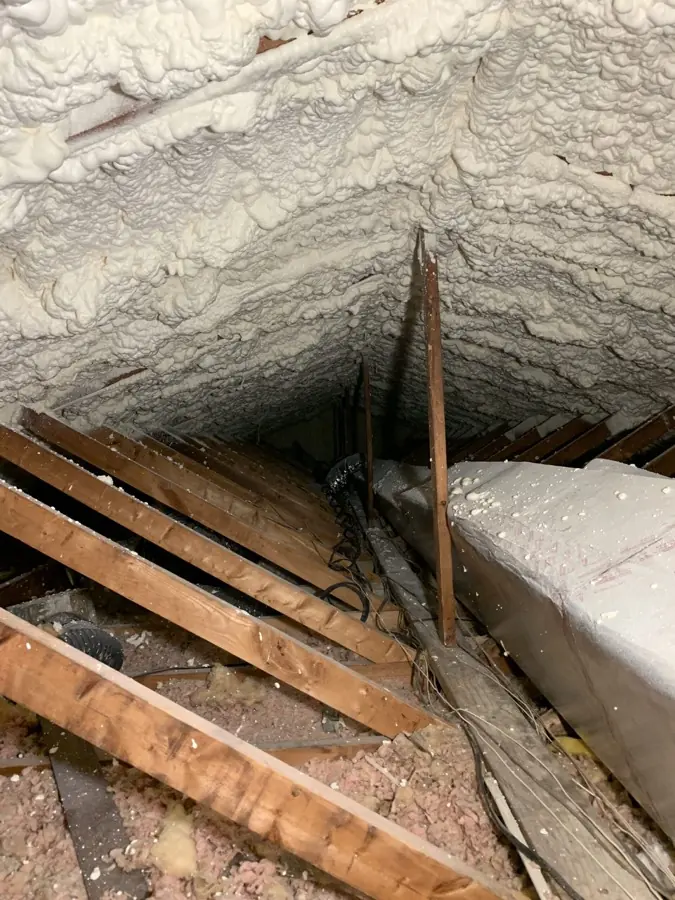
Sprayed at the roof deck, the attic comes inside the envelope. Ductwork stops sitting in 140-degree air, and the AC stops fighting it.
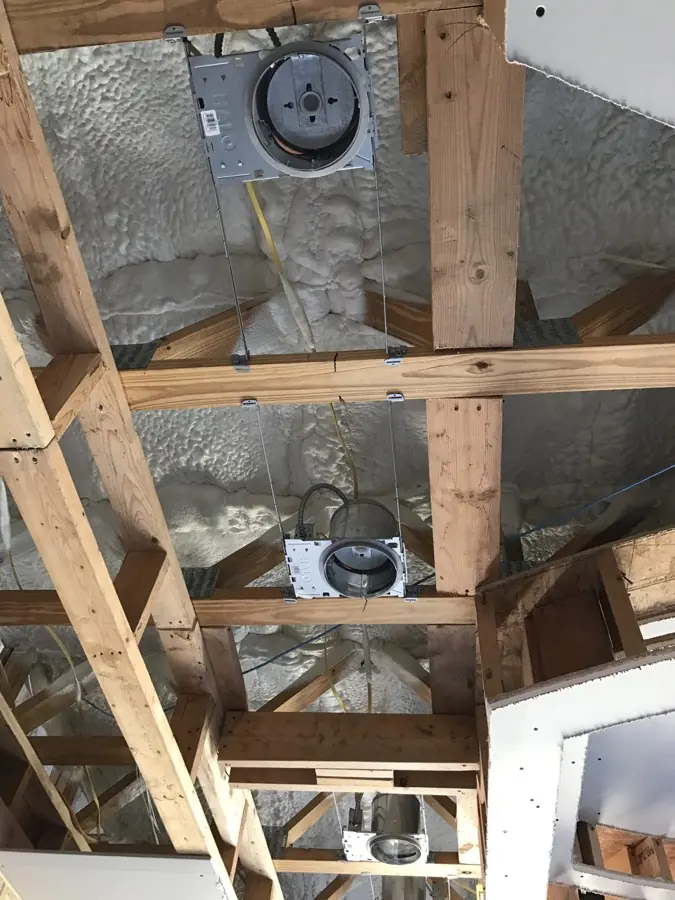
Filled during the framing stage, before drywall. Also the point where sound damping between rooms is basically free.
Closed-cell only. Seals the floor from ground moisture and keeps humid air out from under the house.
Bare steel sweats. Closed-cell against the panel stops condensation and cuts the cooling load in a shop or warehouse.
Most insulation advice online is written for climates where the problem is keeping heat in. Ours is the opposite. From Pharr to San Antonio the load is cooling — and it runs eight months a year, not three.
Two things follow from that. First, the attic is where the money is: an uninsulated attic deck in the Valley routinely hits 140°F, and if your ducts run through it, you're cooling air that's already been reheated on the way to the register. Sealing the deck brings that whole space inside the envelope.
Second, humidity is not an afterthought here. Gulf air holds moisture, and an assembly that traps it will grow mold no matter how well it's insulated. That's why the open-cell / closed-cell call isn't cosmetic — permeable foam lets an assembly dry, and closed-cell stops moisture at the boundary. Choosing wrong causes problems that take years to show up.
We spec around both. That's the whole reason we look at the building before we quote it.
"I can't say enough great things about Panda Insulation! They recently did spray foam insulation in my attic, and the results have been absolutely amazing. My house is finally cool, my AC actually shuts off, and even the garage isn't burning up like before. The difference is night and day! The customer service was exceptional. Daniel was extremely professional — he explained everything clearly, answered all our questions, and even followed up after the job to make sure we were 100% satisfied."
"We had excellent customer service and work done from Panda Insulation. They were able to come out very quickly to install spray foam into our attic. Daniel listened to our concerns and was very knowledgable. High quality with affordable pricing."
For most South Texas attics, open-cell at the roof deck is the workhorse: it fills deeply, quiets the house, and costs less per square foot. Closed-cell earns its price where you need moisture control, structural rigidity, or maximum R-value in a shallow cavity — metal buildings, crawl spaces, exterior walls, and anywhere water is a factor. We look at the space before recommending either one.
It depends on square footage, the thickness the space calls for, whether old insulation has to be removed first, and how hard the area is to reach. That's why the estimate is free and done on site — we're not going to quote your attic over the phone and then change the number when we get there.
Yes. Spray polyurethane foam cures within hours of application and becomes inert and stable. During application the crew is in respirators and the space is ventilated; once it's cured, the building is safe to reoccupy. The Icynene and Heatlok systems we use are Greenguard Gold certified for low VOC emissions.
That's the outcome customers report most often — the AC finally cycles off instead of running all afternoon. The Department of Energy puts average savings from air sealing plus attic insulation at about 15% of heating and cooling costs. How much you see depends on how leaky the building was to begin with.
Not always. If the existing insulation is dry, clean, and undisturbed, foam can often go over or around it. If there's been a pest problem, a roof leak, or rodent contamination, it comes out first — foam over a contaminated attic just seals the problem in. We tell you which situation you're in during the assessment.
No cost, no obligation. If foam isn't the right call, we'll tell you that.
Thanks — we'll reach out shortly to set up your free estimate. Need it sooner? Call (956) 929-6539.